You are currently browsing the monthly archive for July 2012.
Well, the birds are exciting too. It’s just that I didn’t plan on the naked Germans in our hotel pool and the screaming spider monkeys that were terrified out of their minds while a dramatic wind storm swept through.
During our weeklong stay at Crystal Paradise in Belize, we added an overnight stay in Tikal, Guatemala to see the ruins and to get in some more birding. I loved the handoff by our guide at the border. Our guide at Crystal Paradise drove us to the border, walked us through Immigration up to the counter, and waiting for us on the other side was our driver who would drive us to Tikal. Easy peasy. That’s how I like border experiences to go.
We drove for an hour or so and our kind driver pointed out where the Guatemala season of Survivor took place. Just outside of Tikal we picked up our personal guide to the National Park–also provided as part of our arrangement with Crystal Paradise. I’ll be honest with you–our guide for the park was less of a bird expert and more a teller of tall tales, weaving in undocumented and unreliable Mayan lore with some pretty far-fetched space-aged wacky thinking. (It was the part about aliens that tipped me off.) I started to get impatient (big surprise!) with the tales and wanted to see some good birds. (Note: I’d been told before going to Central America that you have to be careful of your guides at Mayan Ruins as there’s a lot of embellishment being spun and shared.)
Ocellated Turkey
As our van began to approach the park and our guide told us to look for the Ocellated Turkey I became very excited and hopeful to see one, since the Ocellated Turkey would have been a lifer for both Steve and me. They’re uncommon because of hunting and nowadays they’re mostly found in areas where hunting is not allowed, such as National Parks. It’s because of the safe haven of National Parks that they’ve become quite tame. We saw our first Ocellated Turkey, and then another, and another. In fact, they were crawling all over the place! But I never tired of seeing them. The colors are spectacular and I enjoyed watching the Tom turkeys make a booming sound before displaying. There’s probably a restraining order against me at Tikal now, as I spent most of the afternoon stalking these guys.
Lotsa, lotsa wildlife and avifauna in Tikal
In these Mayan ruins there is a lot of wildlife and bird life due to the fruit trees. We have he Mayans to thank for that who either planted them or dropped seeds, so Mayan ruins are a pretty fantastic place for birding. Take for instance the Montezuma Oropendola (another lifer!) I love this interesting, beautiful bird as well as its fascinating nest, which typically hangs in a group. The Oropendolas were also all over the place and it just killed me to see tourists not even pay attention to them. A coatimundi, yes. Monkeys, yes. But few got excited about the birds. Sigh.
Speaking of monkeys…
Toward the end of the day the wind started to pick up and our Guide of Tall Tales became very worried and urged us to get out of the park–and quickly. This time I believed him. Branches were falling all over the place and I was getting a little scared, to be honest. So were the spider monkeys, which were screaming and squealing at the top of their lungs. If ever there was a sound track for scary moments in the jungle this was it.
We made it out of the jungle and out of the park safely. I imagine the monkeys were just fine too.
…And enter the Naked Germans
Loved our hotel that was right smack dab in the middle of Tikal National Park, aptly named, Hotel Tikal. Cute thatch-roofed rooms and best of all, a pool. Trouble was, there was a group of naked Germans who were also guests and they were cannon-balling into the pool.
“Steve, there’s a bunch of naked men jumping in the pool. They’re speaking German.”
“Of course. That makes sense.” he said.
There were also the brown outs. Electricity is sparse so during the daytime there are periods of time where you have no power. (You also start to get really thirsty about that time and are praying that someone in the main building will have something for you to drink.)
But we could deal with all that. As long as there’s a comfortable bed, a hot shower, meals and drinks, we’re fine. But naked Germans I could do without.
Check out more photos from our Tikal, Guatemala birding adventure. Click on any photo in the gallery below and it will take you to a slide show where they look even prettier.
- Brown Jay
- Coatimundi
- Gray-necked Wood-rails
- Gray-necked Wood-rails preening
- Montezuma Oropendola
- Montezuma Oropendola nests
- Ocellated Turkey
- Ocellated Turkey displaying
- Hotel Tikal
- Hotel Tikal
- View of Tikal community atop one of the ruins
- Taking a break on the steps of one of the ruins at Tikal
- Red-vented Woodpecker
- Scissor-tailed Flycatcher
- Social Flycatcher
- Spider Monkey
- Spider Monkey
- Tikal
- Yucatan Woodpecker
Tired. Exhausted. Dirt under my fingernails. More than my share of mosquito bites.
We were on our way to the airport in Belize to go home after our two-week adventure. Our first week we spent on Ambergris Caye, scuba diving every day and the second week we spent birding at places such as El Pilar, Mountain Pine Ridge, Aguacate, Blue Hole National Park, and even Tikal, Guatemala. But now it was time to go home and my heart ached a little bit at the thought of leaving Belize.
We were squeezing in one more birding trip before our guide, Eric, was to drop us off at the airport. The nervous-Nellie side of me didn’t like the idea of doing some birding right before we caught our flight back home, but Eric assured us that there was time and he promised me that I’d get a good look at some Jabiru Storks at Crooked Tree Wildlife Sanctuary.
That’s all I needed to hear. I wanted to get a good look at a Jabiru Stork. I saw some juveniles–not yet fledged–in Rio Lagartos, Mexico on our honeymoon two years earlier, but it was only through a scope. I wanted a better look.
Eric was not lying. There were birds galore: Jabiru storks, for sure, and herons, egrets, ibis’s, and terns and the list goes on. It was the end of the dry season and the water was low, which was a special treat, as all the birds were concentrated together. Birding was almost too easy.
An osprey swooped down to catch a tilapia from the lake,
we caught a Limpkin eating an apple snail,
and I was fascinated as I watched a heron shadow feed. (Shadow feeding is when the bird makes a shadow with his wings over the water, which helps him see the fish better for feeding. Rather clever, I’d say.)
The birds didn’t seem to mind that we were there. Unlike warblers who flit around dense leaves and play a game of hide and seek, or the toucan, which I never was able to get a good look at, the waders at Crooked Tree seemed to be indifferent about our presence and had no problem parading out in front of us.
I’m not the first and I won’t be the last who will write this: Being out in nature and seeing wildlife–birds in this particular instance–is a very reverential experience.
I find spirituality in churches, synagogues, cathedrals, temples and especially in nature, and the reverence I feel in watching birds astounds me every time, and never so much (at least up to this point) as when I was at Crooked Tree.
Wonderment. Respect. Awe. It’s akin to the feeling I had when I sat in the Sistine Chapel and looked up at Michelangelo’s masterpiece until my neck couldn’t take it any longer. Or when I first heard Bach’s Toccata and Fugue in D minor played live on a big church organ. Yes, sometimes birding gives me spine-tingling moments.
And so who cares that I had dirt under my fingernails. I was in a sacred place and my soul felt cleansed.
More photos of the birds at Crooked Tree Wildlife Sanctuary. Click on any in the gallery below and you will taken to a slide show where you can view it much better.
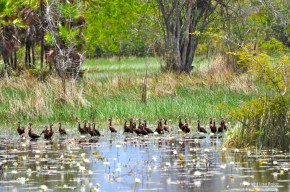
- Black-bellied Whistling Ducks
- Cattle Egret
- Common Egret and Black-necked Stilts
- Common Egret and Snowy Egrets
- Crooked Tree
- Great Blue Heron (There is something lovely about this shot–sort of looks like a watercolor painting.)
- Great Blue Heron
- Green-backed Heron
- Jabiru Stork in flight
- Limpkin with apple snail
- Little Blue Heron – adult
- Little Blue Heron in flight
- Northern Jacana (One of my favorite bird photos of all time.)
- Northern Jacana
- Osprey
- Osprey with tilapia
- Royal Tern
- Snail Kite
- Tri-colored Heron Shadow Feeding
- Vermillion Flycatcher
- White Ibis
- Wood Stork
- Wood Stork
- Wood Storks
It was April 2010 when Steve and I were canoeing down the Macal River in Belize and where I saw my first Prothonotary Warbler. Eric, our guide, excitedly pointed out the colorful yellow bird to us. Now fast forward to the following Spring–May, to be exact–where I saw my second Prothonotary Warbler at Point Pelee in Ontario Canada.
So this means, the little yellow bird flies roughly 5,000 miles each way when migrating. Me? Well I probably take the elevator at work far more often than I should instead of taking the stairs. I’m too lazy to be a Warbler, I suppose.
Maybe that’s why Warblers have conspired against me. You see, they’re the least cooperative of birds (even moreso than hummingbirds!) when I’m trying to take their photo. They flit around dense leaves so much I can hardly get a shot. Most often, I just give up. The one thing I lack that most really good birders have is patience. (Just ask my husband, the real birder in the family.)
Sigh. I’m working on it. I promise.