You are currently browsing the monthly archive for April 2012.

When telling friends I was going to Panama to go birding, most of them thought Steve and I were going to be chasing down exotic birds like Toucans and Parrots. Of course, I always love to see those in the wild, but something that Panama  (along with the other countries in Central America) has is Tanagers. Best kept secret, I tell you.  (Well, that and the fact that cell phone service is crazy cheap there.)

The thing I love about Tanagers is that it’s like all the shoes in my closet.  I’ve got loads of them and they are essentially the same thing–shoes–but they all look totally different. They each have their own style. So finding all these Tanagers was a bit like shoe shopping for me.  (Don’t tell Steve.  I can just see his eyes rolling now.) There are the Cherrie’s Tanager, the Blue-gray Tanager, Summer Tanager, and the Red-legged Honeycreeper, which of course doesn’t have the Tanager name, but Steve tells me is in the Tanager family. And loads more, natch.

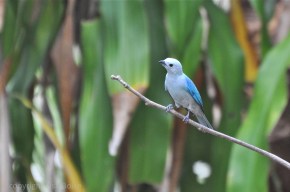
Blue-gray Tanager

I live in Utah and so I don’t see Tanagers that often–I’m lucky if the Western Tanager visits our feeders.  It’s like being stuck owning one pair of shoes.  A lovely pair of shoes, but only one pair.  Sigh. But I still have hope that a Western Tanager will visit when I’m actually home.  (I suspect they wait until I’m at work and visit.) But in Panama we saw a whole bevy of Tanagers and I couldn’t get enough of them.

My all-time favorite Tanager is the Blue-gray Tanager.  Every time I see this guy he’s always posing and pulls some of the most interesting expressions.

Oh, and by the way, Panama City just happens to have a Jimmy Choo store.  Now that makes this girl happy and it’s official–we can totally retire here.

Check out the gallery of Tanagers I have here.  Some shots are better than others. Sadly, I’m still a novice at taking photos.  I’m getting a little better each time, but I need to spend more time out in the field.

Question out there for all of you.  Which Tanager is your favorite?  You don’t need to choose from my gallery here.  Just wondering if any of you have a favorite Tanager you like to see.

Who doesn’t like hummingbirds?

They’re colorful, cute, the smallest of all the birds in the world, buzz around sounding like George Jetson, and can only be found in the Americas. Yep, that’s right. You won’t find one of these fellas buzzing around Europe or Africa.

And Panama has 59 different species of these guys.

Hummingbirds always seem to put a smile on the face of just about anyone.  They’re super fascinating with their sword-like bill, their iridescent colors and if you’re lucky to see, their territorial displays and fights.  The more aggressive hummers use their bills to fight off competition and we saw a few fallen ones several years back when we were marveling at some fighting over some feeders in Costa Rica.

When we were in Panama the last couple of weeks we didn’t see all 59 species, but we saw 26–just about half. And that’s not bad since we were only on the Western half of Panama.

I’d love to have the metabolism of a hummingbird. In just one hour after Ito, our guide in the Cerro Punta area, had refilled one of the feeders at the cabins at Los Quetzales, it was 1/2 empty.  Yet, these little guys don’t appear to be slowed down as much as I am after having a big dinner, (like the big Easter brunch I just finished). Maybe if I were flapping my tiny wings a gazillion times a minute I’d be thirsty too.

Now, I’m not a super exceptional photographer, but I try to practice a lot and hummingbirds give me loads of good practice and material.  Hummingbirds, believe it or not are pretty easy to capture–easier than, say, warblers.  Warblers don’t sit still for one moment.  Hummingbirds, on the other hand, often cue up nearby the feeders on a tree  branch like good little soldiers, giving me terrific opportunities for getting a nice photo. And if the sun is shining just right, I can get some great shots of the iridescent colors these birds are known for.

You’ve just got to be careful not to get in their flight path and it gets really crazy when there are dozens or so (or even 20 or so as it was in several cases on our trip) when they fly right over your shoulder.  To hear them whiz by right next to your ear is both exciting and scary at the same time.

Here are my favorites from our Panama trip of last week and the week before.  Now that I’ve had a chance to sort through them all (I had close to 200 of just hummingbirds), they are ready for your enjoyment  Be sure to click on them to enlarge.

Violet Sabrewing

Violet-headed Hummingbird

Purple-throated Mountain Gem – female

Violet Sabrewing

Black-bellied Hummingbird

Violet-headed Hummingbird

Violet-headed Hummingbird

White-throated Mountain Gem

Violet Sabrewing

Violet-headed Hummingbird

Violet-headed Hummingbird

Green Violet Ear and flowers

White-necked Jacobin displaying

Black-throated Mango

White-necked Jacobin

Blue-chested Hummingbird

Green Violet Ear

Violet Sabrewing – female

Purple-throated Mountain Gem

I hate goodbyes.

We said “goodbye” to Ito in Cerro Punta, said “goodbye” to Beny yesterday after our last birding day with him and tomorrow we’ll be leaving Panama early and saying “goodbye” to a country that has been beautiful, diverse, friendly, adventurous, and all those other words that are easy to grasp.
But most of all, I’ve found Panama to be more like home. I mean that it feels like home. Maybe it’s because they use the U.S. Dollar here, or maybe because the U.S. was present here for so long.

It’s pretty easy to find the little necessities we’ve grown fond of while traveling: Coca Cola (Lite for me), Oreos (why, all of a sudden am I into Oreos?), Red Bull, and Nature Valley granola bars. But we’ve also discovered some new things we love: these little cookies/crackers we found in Cerro Punto that are nothing more than sugar, flour and butter and packages in a little cellophane bag, tied at the top. I could easily eat a whole bag (and almost did). And these great apples that are called Water Apples, which once you’ve taken your first bite, drip with wateriness and is a welcome relief in the humid and hot temps of Panama while birding:

20120401-105733.jpg

20120401-105805.jpg

But it’s not all just about the food. I’ve found the people to all be warm and friendly and try to be as helpful as they can. Panamanians are proud of their birds. People in the regions we visited would point out a unique bird–they know that birds are special in their country and know that people from around the world come to Panama to see their birds.

Steve thinks I’m going to change my mind about moving here once we visit the next country, since he says I want to move to every place where we vacation. But I can totally see us retiring here–what a fantastic jumping off point to see other parts of the world, especially South America, which we have ventured to yet.

With all that said, let me give yesterday’s report. I believe all our diving and birding and bus rides and taxi adventures has taken a toll on us. Well, that and the very hot and humid temperatures. It was a very hot day and Steve and I were moving slowly. Poor Benny. I think he was a little saddened by the fact that he got us at the end of our journey and we were dragging as we’re just not used to this heat.

It was a slow day. We were hot and the birds were hot. We birded around the Gamboa Resort, the Pipeline Road again, but a different trail (further down than three days ago) and then around the Radisson Hotel in Gamboa in the late afternoon where we saw tons of hawks overhead, which decided to rest for the night in the forest right behind the Radisson.

Once I saw the Radisson’s two pools I counseled with Steve and we decided to forego our last night at the Canopy B&B and stayed last night at the Radisson instead. So glad we did. And I recommend to all birders out there who are planning a trip to Panama and the Gamboa region that if you find the Canopy Tower too pricey (it is) then your next bet should be the Radisson. Ask for the 4th, 5th or 6th floor with a forest view. This morning we awoke to  hawks rising from the forest behind us in the thousands and it was a site to behold. Plus, you can cool off in the pools. Food is pretty good, especially the breakfast buffet, which should sustain you. There is also an ATM in the lobby, which is very convenient since there are no services around for miles and miles away.

Yesterday I asked Beny why people don’t say “adios” to each other. When I took Spanish in high school one of the first lessons we had was that “adios” meant “goodbye.”

“Adios is when you’re not going to see each other for a long, long time,” Benny taught me.

Hopefully it won’t be long before we say, “Hola!” to Panama again.

————————–

Here’s our list from yesterday. 87 species and only 7 lifers. The lifers are in bold. More photos at the end.

Magnificent Frigate Bird
Rufescent Tiger Heron (immature)
Turkey Vulture
Black Vulture
Osprey
Mississippi Kite (new for me; Steve’s already seen it)
Broad winged Hawk
Swainson’s Hawk
White throated Crake
Common Moorhen
Southern Lapwing
Wattled Jacana
Royal Tern
Rock Dove
Pale vented Pigeon
Scaled Pigeon
White tipped Dove
Ruddy Quail Dove
Orange chinned Parakeet
Blue headed Parrot
Red lored Parrot
Mealy Parrot
Squirrel Cuckoo
Spectacled Owl
Chimney Swift
Short tailed Swift
Garden Emerald (hummingbird)
Sapphire throated Hummingbird
Rufous tailed Hummingbird
Blue Chested Hummingbird
White throated Plumelteer
Black tailed Trogon
Blue crowned Motmot
Ringed Kingfisher
Amazon Kingfisher
Chestnut Mandibled Toucan
Keel billed Toucan
Red crowned Woodpecker
Black cheeked Woodpecker
Crimson crested Woodpecker
Barred Antshrike
White Bellied Antbird
Yellow bellied Tyrannulet
Yellow Tyrannulet
Common Tody Flycatcher
Panama Flycatcher
Dusky capped Flycatcher
Lesser Flycatcher
Great Kiskadee
Social Flycatcher
Gray capped Flycatcher
Streaked Flycatcher
Tropical Kingbird
Eastern Kingbird
Cinnamon Becard
Purple fruit crow
Yellow green Vireo
Mangrove swallow
Southern rough winged Swallow
Barn Swallow
Gray breasted Martin
Black bellied wren
Bay Wren
Rufous breasted Wren
Buff breasted Wren
House Wren
Clay colored Thrush
Chestnut sided Warbler
Northern Water Thrush
Rosy Thrush Tanager
White shouldered Tanager
Crimson backed Tanager
Palm Tanager
Golden hooded Tanager
Red legged Honey Creeper
Streaked Saltator
Blue black Grassquit
Variable Seedeater
Thick billed Seed finch
Blue Black Grosbeak
Giant Cowbird
Great tailed Grackle
Baltimore Oriole
Scarlet rumped Cacique
Yellow rumped Cacique
Thick billed Euphonia

And a big ass locust

20120401-113947.jpg

Blue Black Grosbeak

20120401-114106.jpg

20120401-114537.jpg

Enter your email address to follow this blog and receive notifications of new posts by email. Easy Peasy.

I’ll be at TBEX!

Join me at TBEX

Accidental Tweeter

Check out my Accidental Birding board on Pinterest

Follow Me on Pinterest

Fat Birder

Fatbirder's Top 1000 Birding Websites

Nature Blog Network

Nature Blog Network

Ms. Boice (The Accidental Birder)

Am I an Ornithologist? No. Have I been birding all my life? Not even. Can I ID a bird by it's call? Well, if it's a Chickadee I can, and it pretty much stops there. The husband is the real birder. I just take photos and make cheeky comments.

Follow

Get every new post delivered to your Inbox.

Join 216 other followers

%d bloggers like this: